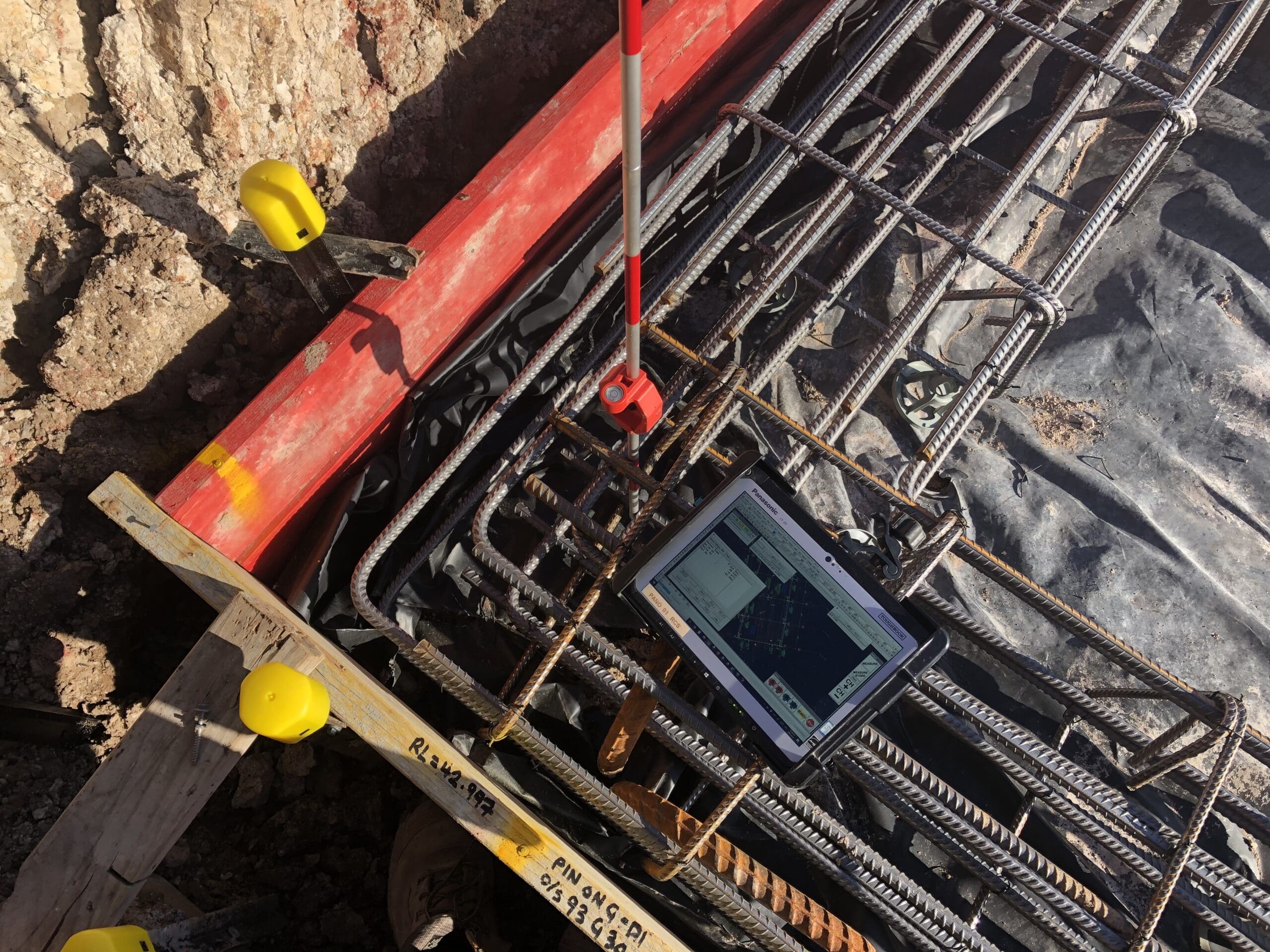
Every civil project starts with a design and ends with a structure. The two are never a perfect match. There is almost always a gap between what the drawings asked for and what got built.
That gap is normal. The question is how big it is, who carries the cost of it, and whether anyone can prove what was actually built. This post breaks down why the gap opens, who pays when it grows too wide, and how good records keep it under control.
Design intent and as-built, in plain terms
Design intent is what the drawings and models say should be built. It is the planned position, level, and shape of every element, from a pipe invert to a bridge bearing.
As-built is what was actually constructed, measured after the work is done. An as-built survey records the finished structure in the field and compares it to the design.
Put simply, design intent is the plan and as-built is the proof. The as-built tells you where reality landed against the plan.
Why a gap almost always opens
A perfect match is rare, and not because anyone did poor work. Several normal things pull as-built away from design:
- Site conditions differ from assumptions. The design is drawn before the ground is fully known. Rock, services, or soft spots that show up during the dig can force small changes.
- The design changes mid-build. Variations come through during construction. If they are not captured cleanly, the field moves on while the records lag behind.
- Construction tolerances. No structure is built to an exact figure. Each element lands somewhere inside its allowed band, and those small offsets add up across a structure.
- Undocumented field decisions. A service gets shifted to clear a clash. A pit moves half a metre. If that change never makes it back to the model, the gap is now invisible on paper.
- Setout error. A small error early in the build carries through to the finished work. Strong setout keeps this part of the gap small, which is why setout and as-built are two ends of the same thread.
Who pays when the gap is too big
A small, documented gap is fine. A large or unrecorded one starts costing real money, and the cost lands on different parties at different times.
The contractor pays first. Work that falls outside tolerance can be rejected. That means rework, re-survey, and a delayed handover. Payment can be held until the records and the structure line up. On a fixed program, every day of this eats margin.
The asset owner pays later. When a project hands over with as-built records that do not match the ground, the owner inherits the problem. Future maintenance, repairs, and upgrades get planned off wrong information. A pipe that is not where the records say it is can stop a future dig cold, or worse, get struck.
Everyone pays in a dispute. When a gap affects another party, such as an adjoining structure or a shared service, it can turn into a claim. Now there are legal hours, expert hours, and management time stacked on top of the physical fix.
The pattern is the same as setout. The longer the gap goes unrecorded, the more it costs to deal with.
Why accurate as-built records protect the whole project
A clean as-built record is not just a closeout document. It does real work long after the crews leave.
- Handover. A clear as-built that matches the structure lets the project close out without arguments. It shows the work was built within tolerance, or shows exactly where and why it was not.
- Operations and maintenance. The owner runs the asset off the as-built. Accurate records mean faster, safer maintenance for the life of the asset.
- Future works. The next project on that site starts from your as-built. Good records save the next team from surveying it all again.
- Claims defence. If a dispute ever lands, a dated, accurate as-built is strong evidence of what was built and when.
As-built on major infrastructure
On large infrastructure jobs, as-built records get real scrutiny. Asset owners, certifiers, and the next delivery team all lean on them. Progressive capture matters even more here, because the structures are bigger, the services are denser, and a buried error is far harder to recover. Treating as-built as a running task through the build, rather than a rush at the end, is what keeps the final record clean and the handover smooth.
When and how to capture as-built well
The biggest mistake is treating as-built as a single job at the end. By then, much of the work is buried or covered. Better practice spreads the capture across the build.
- Capture progressively. Survey services, footings, and drainage before they are covered. You cannot measure a pipe once the trench is backfilled.
- Match the method to the geometry. A total station or GNSS suits straightforward features. For complex or high-detail structures, laser scanning captures the whole geometry at once, with nothing missed.
- Agree tolerances and formats up front. Decide early what counts as in tolerance, and what file formats the owner needs. This avoids a reformat scramble at handover.
- Tie as-built to the same control as setout. When the as-built references the same control network the build was set out from, the comparison is true. Different control means you are comparing two different worlds.
The link between setout and as-built
Good setout and accurate as-built are two ends of the same control thread. Setout puts the design on the ground. As-built checks how close the finished work came. Both reference the same control, and both depend on the same discipline.
When the setout is tight and the as-built is captured progressively, the gap stays small and provable. That is what a clean handover looks like.
Reliable construction surveying closes the loop from design to setout to as-built, so the record matches the build. To see how we support this across major infrastructure work, explore our projects, or get in touch to talk through your delivery.