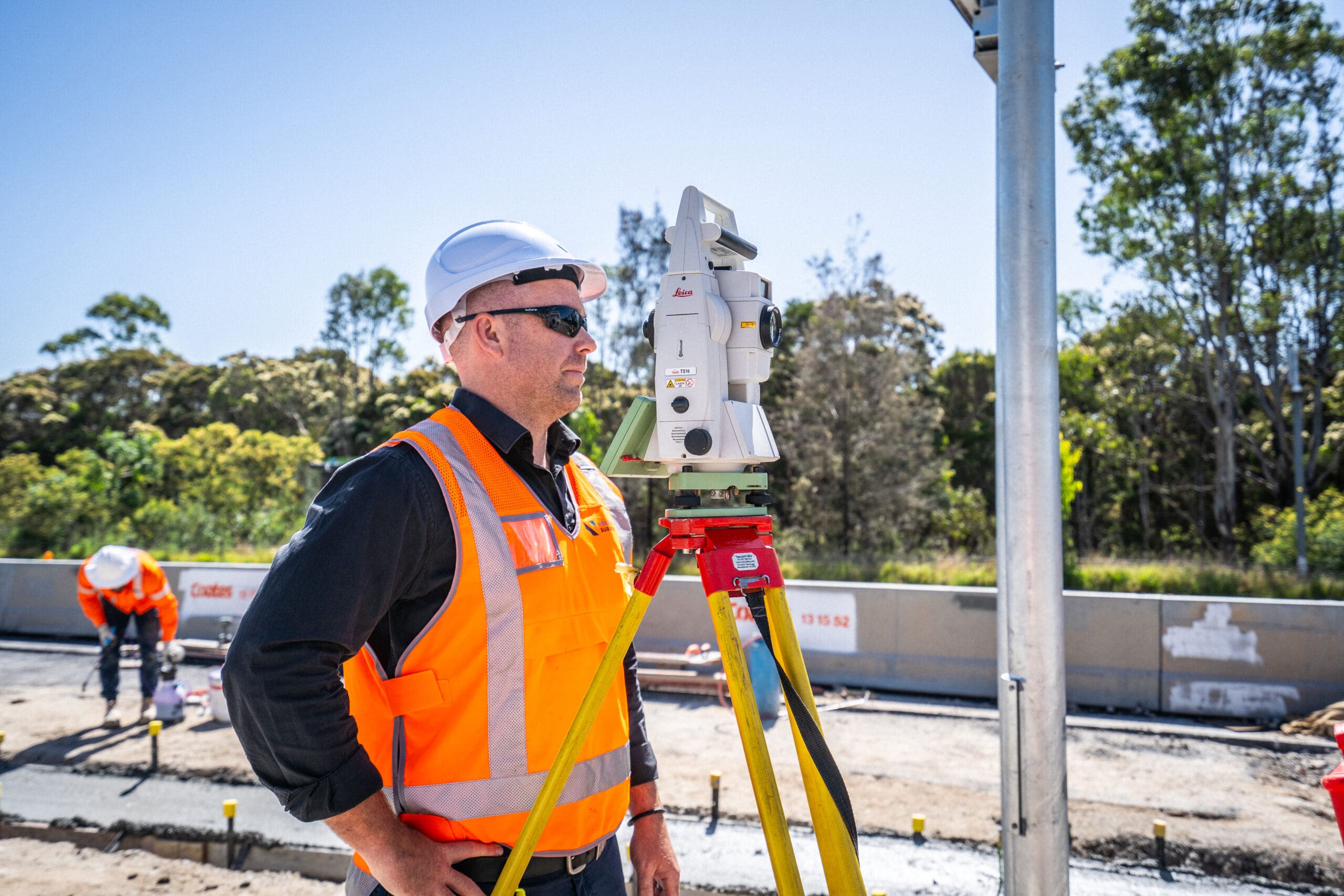
On a civil project you will hear both terms used, sometimes as if they mean the same thing. They do not. Engineering survey and construction setout are closely related, and they often involve the same people and gear, but they cover different ground. Knowing where one ends and the other begins helps you scope the right service and avoid the gaps that cost time later.
What engineering survey covers
Engineering survey is the broad discipline that keeps a civil project geometrically correct from start to finish. It is the survey work that supports the engineering, and it runs across the whole job.
It usually includes:
- Establishing and managing the control network the project is measured from.
- Capturing existing conditions, such as topographic and feature survey, to inform the design.
- Setting out the design on the ground (setout sits inside this).
- Checking the build with as-built and conformance survey.
- Measuring quantities, such as earthwork volumes.
- Advising the engineering team on anything geometric, from datums to tolerances to accuracy.
Put simply, engineering survey is the framework. It sets the rules for position and level, holds the accuracy together, and gives engineers reliable measurements to make decisions from.
What construction setout covers
Construction setout is the field task of marking the design onto the ground so crews can build to it. A construction setout crew takes the design data and stakes out line and level: kerb lines, pile positions, pit locations, slab edges, and levels for earthworks and structures.
Setout is hands-on and time-critical. It happens at the work face, often just ahead of the trade that needs it. The job is easy to state and hard to do well: put the right mark in the right place, inside tolerance, at the right time.
Where they overlap
The overlap is real, which is why the terms get mixed up. Setout is part of engineering survey. The same crew that manages control and captures as-built often does the setout too, with the same instruments, the same control, and the same design data.
So setout is not a separate thing from engineering survey. It is one task within it, the task that touches the build most directly.
Where one ends and the other begins
Here is the clean way to think about it. Engineering survey sets and holds the framework. Construction setout applies that framework at the work face.
- Engineering survey establishes the control, confirms the datum, and protects the accuracy. Setout works from that control to mark the design.
- Engineering survey captures and checks, with topo before and as-built after. Setout is the step in between that puts the design on the ground.
- Engineering survey answers a project-wide question: is the whole job geometrically right? Setout answers a local one: is this element in the right place to build right now?
When the framework is strong, setout is straightforward. When the framework is weak, no amount of careful setout can save it, because the marks point back to something that does not hold.
A quick example
Take a drainage run. Engineering survey sets the control and confirms the design invert levels against the datum. The setout crew marks the line and levels for the pipe crew to build to. Once the pipe is laid, as-built survey records where it actually went, before it is backfilled. Three steps, one control, one consistent record. Drop any step, and the audit, or the next contractor on that site, finds the gap.
Why the distinction matters for scoping
Mixing the two up causes scope gaps. A contractor who books “setout” but assumes control and as-built are part of it can find those tasks fall to no one. The setout lands fine, then handover stalls because the as-built and conformance records were never in anyone’s scope.
Scoping both clearly, the framework work of engineering survey and the field work of setout, means nothing slips through. The control is managed, the setout is done, and the as-built closes the loop. It also helps when comparing quotes, because two prices for “setout” can cover very different scopes once you ask what framework work sits behind them.
What happens when they are split across parties
Problems show up when setout goes to one party and the control and as-built go to another. The two can end up referencing different control, or keeping separate records that do not line up. At conformance, those seams show. The setout might be fine on its own, yet the as-built tells a different story because it was tied to a different frame.
Keeping both under one team avoids this. One control network, one set of records, one point of accountability from the first mark to handover. That is far harder to achieve when the survey scope is carved up between crews who never share a single frame.
Which one does your project need?
Most civil builds need both, run as one service. The control has to be set and held, the design has to be staked out, and the as-built has to close the loop. On a smaller job, you might engage setout only, with the principal managing the control and as-built in house. Either way works, as long as one thing is clear from the start: who holds the framework. The common trap is assuming the framework is someone else’s job when no one has actually picked it up.
How they work together
On a well-run project, the two flow as one service. Engineering survey stands up the control and the design data. Setout marks it out as the build progresses. As-built checks it against the design. Each step references the same control, so the whole job stays consistent from the first mark to handover.
Strong construction surveying brings both together under one team, so the framework and the field work never drift apart. To talk through the right scope for your project, get in touch.