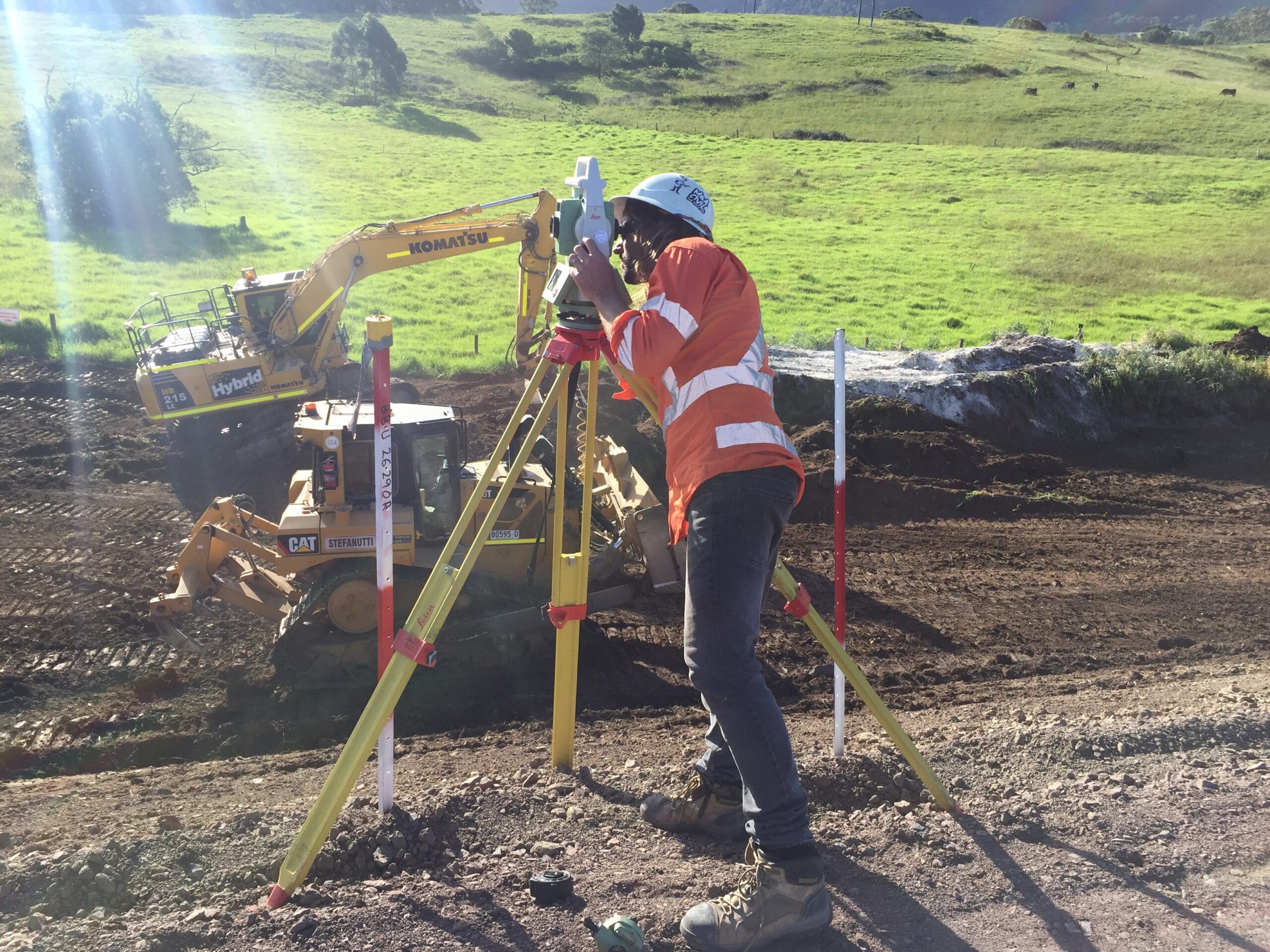
Setout is one of the first survey jobs on a civil site. It means marking the design onto the ground so crews know where to build. Pegs, marks, and reference lines show where a kerb, pile, pit, or slab edge goes.
When setout is right, work flows smoothly. When it is wrong, the cost grows fast, and it is rarely just the price of moving a peg.
Here is where setout goes wrong, what it really costs, and how to stop those errors before they reach the ground.
What setout actually does
Every part of a civil build starts from survey marks. A construction setout crew takes the design and stakes it out in the field. They set line and level for earthworks, drainage, pavement, structures, and services.
These marks are the link between the drawing and the dirt. If the marks are off, the build is off. A structure can look correct on site and still sit in the wrong place by design.
That is what makes setout risk easy to miss. A small error often hides until a later check, or until two trades meet and the clash shows up.
Why tolerances make setout unforgiving
Civil work runs to tolerances. A tolerance is the allowed range around the design value. Some elements allow only a few millimetres. Others allow a little more. Either way, the finished work has to land inside that band.
Tight tolerances leave no room to absorb a mistake. If the survey marks are out by even a small amount, that error eats into the tolerance before the crew has done anything wrong. Add a second small error on top, and the work falls outside the band.
So setout is not just about marking a point. It is about marking it inside a budget of error that other people have already partly spent.
Where setout goes wrong
Most setout errors trace back to a few causes:
- Weak or unchecked control. Setout is only as good as the survey marks it works from. If the control is wrong or has been disturbed, every reading inherits that error.
- Old or superseded design. A crew sets out from a drawing that has since changed. The peg is accurate to the wrong version.
- Transcription slips. A figure gets keyed in wrong, a string is mislabelled, or a level is read against the wrong datum.
- Rushed or solo work. With no independent check, a single mistake goes straight to the field and no one catches it.
- Gear that has drifted. A total station or GNSS rover that has not been checked can read off without any obvious sign.
None of these look dramatic on the day. That is the problem. They surface later, when fixing them is far more expensive.
The real cost when setout slips
The real cost of a setout error lands downstream, in rework, delay, and wasted materials. The survey time itself is a tiny part of the total.
Rework. Concrete that has cured in the wrong spot has to come out. Pits dug off line have to be filled and re-dug. Steel fixed to the wrong setout has to be cut and reset. Each of these burns labour, plant, and materials that were already paid for once.
Program delay. Rework does not slot neatly into the schedule. It pushes the trade behind it, then the next one. On a tight civil program, a few days lost early can grow into weeks by handover.
Wasted materials. Demolished work is rarely recoverable. The spoil, the broken concrete, and the scrapped sections all carry a disposal cost on top of the loss.
Disputes and claims. When an error crosses a boundary or affects another party, it can turn into a claim. Now there are legal and management hours on top of the physical fix.
Reputation. On infrastructure work, the contractor who keeps causing rework gets remembered. Repeat work and references depend on a clean delivery record.
We will not put a single number on this, because every project is different. The pattern holds across civil work though: the later a setout error is found, the more it costs to fix. An error caught at the peg costs minutes. The same error caught after the pour can cost days.
A note from major project work
On large infrastructure jobs, the margin for setout error is thin. Tolerances are tight, programs are fixed, and many trades work off the same marks at once.
That is why precise setout matters most on the projects where the stakes are highest. Across the major projects we support, from motorways to rail and water infrastructure, setout is treated as a control point for the whole build, not a box to tick. Getting it right early is what keeps the rest of the program clean.
How to stop setout errors before they cost you
Setout errors are preventable. A few habits remove most of the risk:
- Start from strong control. Verify the control marks before any setout begins. Check they have not moved and that they sit on the right datum.
- Work from the current design. Confirm the drawing or model version before staking. One quick check stops a whole day of accurate work on the wrong file.
- Build in an independent check. A second set of eyes on critical setout catches the slips a single person cannot.
- Keep gear calibrated. Regular instrument checks keep readings honest and traceable.
- Use experienced crews. People who have run setout on complex civil sites read the risk early and flag it before it reaches the ground.
These steps cost a little time up front. They save far more than that in avoided rework.
The bottom line
Setout sits at the start of the build, so its errors travel through everything that follows. The fix is not complicated. It is strong control, the right design, an independent check, and crews who know what to look for. That is the difference between a quiet handover and a program full of rework.
Strong construction surveying starts with setout you can trust. If you want a setout crew that treats accuracy as the first line of defence on your program, talk to our team.